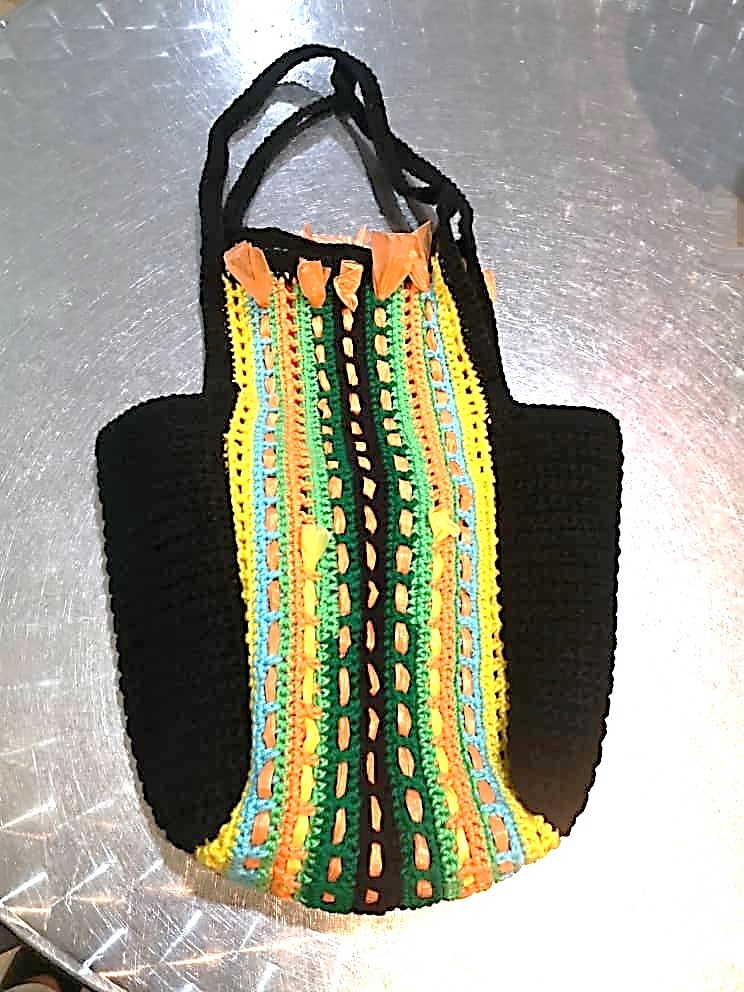
You can find free products or materials for making crafts everywhere. If you look out for them, you can find them:
-in your home.
-at work.
-from your friends and neighbours.
-at restaurants, stalls or shops you often patronise.
-in public areas.
You just have to try to get your hands on them before they are discarded. I see many material you can work with in this bin. Can you spot them too?

If you are good at painting, instead of buying drawing pads, you can consider painting on empty glass bottles. This is a gift I received from a friend in Beijing. It is a painting of my husband and son on a snuff bottle. The artist who created it managed to copy the likeness from a photo I gave my friend.

I think that is a neat idea. So, if you have recently celebrated with a bottle of champagne, instead of throwing the empty bottle away, you can either do it yourself or find an artist to have your photo painted on it to commemorate the event you opened it in celebration.
What are you good at making? You can list out the tools and material you need to complete your work on a piece of paper and note beside it what other material you can consider using as substitutes. Some crafting tools can be expensive. So, use your creativity to improvise with the available tools or material that you have on hand to complete your craft.
For example, when I was learning to make wirework jewellery, I discovered that I could use as working material:
-the copper wires removed from leftover electrical cables.


These are the tools I made use of to create jump rings…


I love using material that would otherwise be discarded in my craftwork. I call my efforts, creating abundance from the abandoned. Since I enjoy handcrafting, I am always on a look out for free crafting tutorials online. But instead of buying new material to create, I tend to use discarded material. For example, at my bike shop I have lots of punctured tubes to work with. Instead of using ribbons, here are some of the things I can create with punctured tubes.


Punctured tubes can be used to cover a hole in a chair.


I have also experimented with used tyres from my bike shop. My customers used to enjoy sitting on this chair I created with them while they were waiting for their bicycles to be fixed. However, the raffia strings I used to tie them together disintegrated over time. So, if you are inspired to create the same, you have to use stronger material as fastenings.

You can also upcycle clothes you or your family members have outgrown. To upcycle means, to reuse discarded material in such a way that it creates a product of higher quality or value than the original. What you are able to create yourself will be valued. With some creativity, anything can be upcycled. If you do not want to upcycle your clothes but you are not comfortable about wearing them again because you have worn them one time too often or they have gone out of fashion, you can learn to embellish them by adding decorative details so that they look different. That will require you to take up some basic sewing skills though.
Currently, I save all crafting tutorials with potential to create with free material on my Pinterest board, “Abundance from Abandoned”. From there you can explore the free material you can use in your craft.
This video gives you an idea what you can craft with fruit foam wraps.
Once you have discovered the kind of free material you would like to work with, tell everyone you know to keep them for you. And be friendly with storekeepers of shops you often buy your stuff from as they may have lots of packaging material which you can make use of in your craft.
These are the other practical stuff that I have made over the years with free material:
I managed to create this weaving tool with my empty herb supplement bottle. Instead of yarn, I cut strips out of plastic bags to weave.

These watering pals for watering plants are made of PVC bottles and dressed up with plastic bags.

For my former kitchen.

This is how I decorate empty containers for storing my stuff.


Costumes and hair pieces I made for school concerts to reduce the cost of paying for clothes that my children may only wear once during their performance.


Bouquet cum duster that I designed and made with plastic bags which can be given out as gift.

With these creations, I was able to conduct a workshop on recycling and upcycling for some university students in UTAR during one of their extramural activities.

Musical instrument I created for my children to play with.

I designed and created this dog poo scoop with a PVC bottle and some plastic bags. I hope owners taking their dogs out for walks at the public park in the neighbourhood will learn to make them so that it will be easier for them to clean up after their pets.

This new year greeting in Malay for display at my bike shop is made of cardboard and strips of plastic bags.

Placard I made for my bike shop to inform my customers when it will closed for the festive holidays.

Before I started my bike shop, I often collect my free cardboard boxes from my regular fruit stall. These are some of the stuff I am able to create with my collection:
Mini cupboard

It was made wide enough for me to use empty tissue boxes as drawers.

You can see how I made it at the following link::
Here is a lantern I made for my children.

You can see how the box was cut and pieces assembled at the following link:
I have been collecting empty sachets for coffee because there is a thin film of aluminium foil inside. I discovered that they can be cut and folded to create a bag like this.
You do not have use the sachets inside out if they have lovely designs on it.
I prefer to crochet over making bags out of this material and will gladly give them away to anyone interested to collect. When I crochet I also consider using cut strips from plastic bags or raffia strings as yarn in my work.

Items that would otherwise be discarded can become valuable to others if it has sentimental value. That said, have you ever thought of using fallen hair to create craft? You can learn the process of creating hairwork by watching this video.