The art of recycling for a greener environment starts with seeing trash as "abandoned material" so that we can create "Abundance from the Abandoned" in "Amazing Ways".
You can find free products or materials for making crafts everywhere. If you look out for them, you can find them:
-in your home.
-at work. -from your friends and neighbours. -at restaurants, stalls or shops you often patronise. -in public areas.
You just have to try to get your hands on them before they are discarded. I see many material you can work with in this bin. Can you spot them too?
If you are good at painting, instead of buying drawing pads, you can consider painting on empty glass bottles. This is a gift I received from a friend in Beijing. It is a painting of my husband and son on a snuff bottle. The artist who created it managed to copy the likeness from a photo I gave my friend.
I think that is a neat idea. So, if you have recently celebrated with a bottle of champagne, instead of throwing the empty bottle away, you can either do it yourself or find an artist to have your photo painted on it to commemorate the event you opened it in celebration.
What are you good at making? You can list out the tools and material you need to complete your work on a piece of paper and note beside it what other material you can consider using as substitutes. Some crafting tools can be expensive. So, use your creativity to improvise with the available tools or material that you have on hand to complete your craft.
For example, when I was learning to make wirework jewellery, I discovered that I could use as working material:
-the copper wires removed from leftover electrical cables.
I managed to use them to learn to make Roman bracelets from a book I borrowed from the library.
-the trolling stainless steel wires that my husband no longer use.
These are the tools I made use of to create jump rings…
…to create this beaded necklace.
I love using material that would otherwise be discarded in my craftwork. I call my efforts, creating abundance from the abandoned. Since I enjoy handcrafting, I am always on a look out for free crafting tutorials online. But instead of buying new material to create, I tend to use discarded material. For example, at my bike shop I have lots of punctured tubes to work with. Instead of using ribbons, here are some of the things I can create with punctured tubes.
Punctured tubes can be used to cover a hole in a chair.
Instead of buying leather, I experimented with tubes to learn leather craft.
I have also experimented with used tyres from my bike shop. My customers used to enjoy sitting on this chair I created with them while they were waiting for their bicycles to be fixed. However, the raffia strings I used to tie them together disintegrated over time. So, if you are inspired to create the same, you have to use stronger material as fastenings.
Do you like crafting with fabric? My uncle used to work for a textile wholesaler. He gave my mom lots of fabric samplers and unsold leftover fabric at the end of each roll. My mom was able to sew quilted blankets, cushion covers and floor mats with the scraps of fabric received. If you require fabric in your craftwork, see if you have friends who enjoy sewing or who are in the tailoring business. They should be willing to give you their scraps. I used to receive used zips and scraps of fabric from a friend who is a tailor. That was because I told her once that jewellery can be created even with damaged zippers.
You can also upcycle clothes you or your family members have outgrown. To upcycle means, to reuse discarded material in such a way that it creates a product of higher quality or value than the original. What you are able to create yourself will be valued. With some creativity, anything can be upcycled. If you do not want to upcycle your clothes but you are not comfortable about wearing them again because you have worn them one time too often or they have gone out of fashion, you can learn to embellish them by adding decorative details so that they look different. That will require you to take up some basic sewing skills though.
Currently, I save all crafting tutorials with potential to create with free material on my Pinterest board, “Abundance from Abandoned”. From there you can explore the free material you can use in your craft.
This video gives you an idea what you can craft with fruit foam wraps.
Once you have discovered the kind of free material you would like to work with, tell everyone you know to keep them for you. And be friendly with storekeepers of shops you often buy your stuff from as they may have lots of packaging material which you can make use of in your craft.
These are the other practical stuff that I have made over the years with free material:
I managed to create this weaving tool with my empty herb supplement bottle. Instead of yarn, I cut strips out of plastic bags to weave.
These watering pals for watering plants are made of PVC bottles and dressed up with plastic bags.
For my former kitchen.
This is how I decorate empty containers for storing my stuff.
Costumes and hair pieces I made for school concerts to reduce the cost of paying for clothes that my children may only wear once during their performance.
Bouquet cum duster that I designed and made with plastic bags which can be given out as gift.
With these creations, I was able to conduct a workshop on recycling and upcycling for some university students in UTAR during one of their extramural activities.
Musical instrument I created for my children to play with.
I designed and created this dog poo scoop with a PVC bottle and some plastic bags. I hope owners taking their dogs out for walks at the public park in the neighbourhood will learn to make them so that it will be easier for them to clean up after their pets.
This new year greeting in Malay for display at my bike shop is made of cardboard and strips of plastic bags.
Placard I made for my bike shop to inform my customers when it will closed for the festive holidays.
Before I started my bike shop, I often collect my free cardboard boxes from my regular fruit stall. These are some of the stuff I am able to create with my collection:
Mini cupboard
It was made wide enough for me to use empty tissue boxes as drawers.
I have been collecting empty sachets for coffee because there is a thin film of aluminium foil inside. I discovered that they can be cut and folded to create a bag like this.
You do not have use the sachets inside out if they have lovely designs on it.
I prefer to crochet over making bags out of this material and will gladly give them away to anyone interested to collect. When I crochet I also consider using cut strips from plastic bags or raffia strings as yarn in my work.
Items that would otherwise be discarded can become valuable to others if it has sentimental value. That said, have you ever thought of using fallen hair to create craft? You can learn the process of creating hairwork by watching this video.
Have you heard about kombucha? It is a fermented tea. I read that it originated in China and other parts of Asia over 2000 years ago.
To brew it, you will need:
-water -tea -sugar -SCOBY (Symbiotic Colony Of Bacteria and Yeast) pellicle with kombucha (the starter tea)
A new batch can be brewed with just the kombucha as starter tea as the SCOBY culture is present in it but it will take a longer time to ferment without the pellicle. The SCOBY pellicle is usually supplied with kombucha. However, if you only have the pellicle, you can use two tablespoon of distilled white vinegar to replace the kombucha as the starter tea. New SCOBY pellicles will form as a by-product of the fermentation process.
I became interested in learning about kombucha when I found out that the SCOBY pellicles used in the production of kombucha can be dried to become a leather like fabric that you can use as art and craft material. Watch this video to see how the material can be created with kombucha.
As shown in the above video, you can make SCOBY pellicles in petri dishes:
-by pouring two tablespoon of kombucha (must be unflavoured starter tea) into each dish.
If your intention is to make art and craft material with the SCOBY pellicles produced, you can:
-add colourings of your choice to each dish.
-leave them to ferment for 2-3 weeks till pellicles are formed.
-check thickness of pellicles.
-when thick enough, take them out of the dishes to dry under the sun for a day. -bring them in to air dry in a well ventilated area.
You can start crafting with them when they are dry. As to what you can make with them, check out videos shared at GiY: Bio Buddies. I like how they were able to make lanterns with them.
Other than that, why should anyone take the trouble to brew kombucha? Based on my research, it is a beverage filled with:
-amino acids
-vitamins B -vitamins C
-minerals
-antioxidants
-probiotics
Drinking it regularly will:
-boost immunity.
-enhance mood.
-fight allergies.
-detoxify and defend body of infection and disease.
-detoxify liver which will put you in a happy mood.
The tea you buy to brew kombucha should be organic as you do want them coated in pesticides which can inhibit the fermentation and brewing process and can eventually kill your SCOBY. These are the type of tea you can use:
-pure black tea (reported to make it much more flavourful). -green tea -white tea -oolong tea -hibiscus tea -a blend of the above
You should avoid using teas:
-that are scented or flavored teas which can effect the growth of your kombucha culture.
-like Earl Grey that will introduce naturals oils as they float on top and suffocates the SCOBY.
-like Chai which contains cinnamon, cloves and cardamom, all of which have antibacterial properties, that will kill the SCOBY. -that are herbal like peppermint or chamomile as they will not be able to provide the nutrients necessary to feed your kombucha culture.
Do not start the process till you have the following utensils on hand:
-stock pot or sauce pan -long *wooden spoon
-glass jar with a wide opening to ease adding or removing SCOBY pellicles in size of:
1/2 gallon or 2 quarts (64 oz / 1.9 Liter) glass jar - 2 units
-Tightly woven cloth to cover the jar like:
clean napkins or tea towels or
coffee filters or
paper towels
-Airtight Bottles: Six 16-oz glass bottles with plastic lids or swing-top bottles or clean soda bottles
-Small funnel to ease pouring into bottles
*Note: prolonged contact between the kombucha and metal both during and after brewing can affect the flavor of your kombucha and weaken the SCOBY pellicles over time.
To start, wear a pair of gloves and spray Isopropyl Alcohol (IA) on the utensils you will be using:
-spoon -sauce pan -jars -funnel -cookie tray work surface (if you are also making kombucha leather)
Here are the steps based on all the articles I have read about brewing kombucha.
If you still have doubts about your ability to start, you can watch this video I found on You Brew Kombucha Youtube Channel as the brewer shares a lot of answers to questions that you are most likely to ask as you start brewing your own kombucha.
You can also learn from Raw Brewing on how to start a Kombucha Brew Log so you can record the processes correctly. It will help you nail the acidic flavour that you prefer best for your kombucha.
Once you have started brewing your own kombuca and have a collection of pellicles in your SCOBY hotel, check out this article:
How do you dispose of mechanical or electrical items that cannot be repaired? It is likely that you will send the damaged unit out to be recycled. That was what my sister-in-law did with her microwave oven. I had the same model and when mine was damaged, I kept the large ceremic plate in it and it became the best cutting board I ever have.
It will be easier for you to decide what to do with your mechanical or electrical items that cannot be repaired if you know what they are made of. I am sure that there are parts on them that you could re-use for other purposes. Most of the time I get my inspirations from Pinterest if I want to upcycle something I have in my craftwork.
Recently, someone asked on Zero Waste Facebook page how she can dispose of her damaged clock and watches. I did a search on Pinterest for "upcycle damaged watch" and I like what I saw there. I think it is a great way to keep momentos of watches you or someone in your family have been wearing throughout their life.
I will definitely hang on to the plate from my new microwave oven if it breaks down on me one day because it should work out nicely as the face for a clock one day.
I also like how watches can be remodeled to become a locket bracelet.
You can learn how to do that at the following link:
And as usual, there are people out there who make a living selling parts salvaged from watches and clocks. They could be purchased by watchmakers who need parts that are no longer manufactured to repair antique watches. They could also be purchased by crafters. This looks like an interesting bracelet to own.
Wednesday, 8 March 2023
I like keeping empty bottles with grooves on them. They make it easier for me to cut the bottles neatly to the height I want. I use this 1L size oval shaped container to store all the brushes I used in my kitchen. Sometimes I will also leave my knives with the brushes to drain them after washing.
Check out how I decorate the empty containers I used for storing my stuff. The one decorated with granny squares was actually a lantern I made for my children. These 5L cooking oil bottles are great for storing my packets of coffee, onions and tubers.
Other than using them as storage containers, I also use them like a pail for soaking in water:
-my laddles to soften food stuck on them to make it easier to clean. -my vegetables like celery, beans, tomatoes, bell peppers. I place a prestle or a cup on top to make sure that the vegetables stay in the water.
Recently, I discovered that it is a great way to keep the shape of my crochet bag. I made it because my sister told me that, while at work, she don't like to carry her handbag out for lunch and that she is looking for a small bag big enough to hold just her keys, handphone and a packet of tissue. The first one I made did not hold its shape well once she puts her stuff in.
I like this version better.
She can decide how much of the bottle she would like to cut off to hold her stuff. The cord I used as a handle was taken off a shopping bag.
So, she can easily change the colour with cords she can find from her own collection of paperbags. She can even use her shoes laces.
I chose a pattern with large holes so that she can slip receipts through them as it will be easier for her to remove them to show the staff when her dishes are ready for collection. She can also personalise it by inserting one of those drawstring bags we often received with gifts.
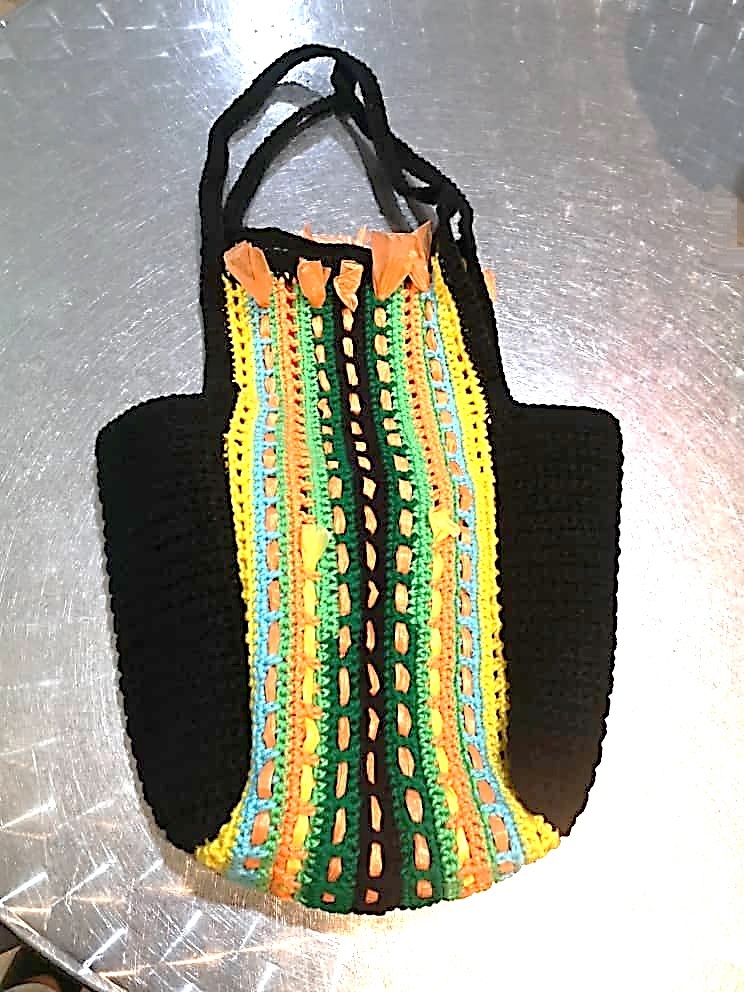
I hope she will consider inserting cut strips of plastic bag through the holes to match her outfit like I did for this bag I made with leftover wools.
If old clothing can have a say in how they should be used, this will be its autobiography.
Other than donating your old clothing, what else can you do on a personal level with clothes that you or your family members no longer wear? Maybe reading this book, "The Upcycled T-Shirt: 28 Easy-to-Make Projects That Save the Planet Clothing, Accessories, Home Decor & Gifts" will give you some ideas.