Take a breather from complaining about plastic bottles littering the environment and take a look at this video.
Don't you like it that you can now process plastic discards into something useful again?
And, don't worry about the cost of getting the machines you need to start because, you are going to learn to make your own with affordable basic materials at Precious Plastic.
Showing posts with label Useful websites. Show all posts
Showing posts with label Useful websites. Show all posts
Sunday, 10 April 2016


Friday, 4 November 2011
Broken? Fix it and share.
Are you good at fixing things up? If you are, wouldn't it be great if you could share your expertise online? What for? Just imagine the number of devices you can save from ending up in the dumpsters earlier than it should. That should make you feel like a eco friendly hero, right?
Like that feeling? Then go to "Self-Repair Manifesto - iFixit" to see how you can join fellow heroes, build a free repair manual for broken devices.
Ka ching. Hear that too? Money can be saved! Before shopping for a replacement for that broken whatever, check out ifixit Manual to see if any heroes have posted a "how to fix it" guide. And if you can't find it, post the problems you have using your device. Your questions could well develop the next eco friendly hero at Self-Repair Manifesto, hero.
Yeah, right! You will make it to the hero list too.
Like that feeling? Then go to "Self-Repair Manifesto - iFixit" to see how you can join fellow heroes, build a free repair manual for broken devices.
Ka ching. Hear that too? Money can be saved! Before shopping for a replacement for that broken whatever, check out ifixit Manual to see if any heroes have posted a "how to fix it" guide. And if you can't find it, post the problems you have using your device. Your questions could well develop the next eco friendly hero at Self-Repair Manifesto, hero.
Yeah, right! You will make it to the hero list too.
Thursday, 22 October 2009
Share this. It's free!
Who need books when you can learn online? Denise shared some educational sites in her slideshow.
Go help save some trees. Take the lead for free lessons or create your own to add.
Education Revolution
View more documents from Denise Caron.
Go help save some trees. Take the lead for free lessons or create your own to add.
Friday, 15 May 2009
Let's join The Dalai Lama
What has The Dalai Lama got to do with a blog about being green? He was the first to sign Buddhist Declaration on Climate Change at EcoBuddhism.
So, what are you waiting for? Let's sign this declaration.
From My InBox:
Dear Friends,
I am sending you the link to a Buddhist Declaration on Climate Change, which I helped to compose, along with David Loy and John Stanley, a British micro-biologist. If you agree with the statement, please sign it and return it to the Ecobuddhism website. Thank you.
Please also pass it on to your own Buddhist friends and colleagues. Those involved with organizations should feel at liberty to post the declaration, or a link to it, on their websites.
http://www.ecobuddhism.org/buddhist-declaration.php
--
Ven. Bhikkhu Bodhi
Chuang Yen Monastery
2020 Route 301
Carmel NY 10512
U.S.A.
Giving concrete expression to the Buddha's great compassion in today's world: http://www.buddhistglobalrelief.org/main.html
For lectures and teachings:
http://www.bodhimonastery.net/bm/
So, what are you waiting for? Let's sign this declaration.
From My InBox:
Dear Friends,
I am sending you the link to a Buddhist Declaration on Climate Change, which I helped to compose, along with David Loy and John Stanley, a British micro-biologist. If you agree with the statement, please sign it and return it to the Ecobuddhism website. Thank you.
Please also pass it on to your own Buddhist friends and colleagues. Those involved with organizations should feel at liberty to post the declaration, or a link to it, on their websites.
http://www.ecobuddhism.org/buddhist-declaration.php
--
Ven. Bhikkhu Bodhi
Chuang Yen Monastery
2020 Route 301
Carmel NY 10512
U.S.A.
Giving concrete expression to the Buddha's great compassion in today's world: http://www.buddhistglobalrelief.org/main.html
For lectures and teachings:
http://www.bodhimonastery.net/bm/
Monday, 2 February 2009
100 Ways to Save The Environment
Check out the "100 Ways to Save The Environment" posted on (SEQL) Sustainable Environment for Quality of Life.
If you like to share the suggestions given there, email its link to your friends. You can also print link to a .pdf copy for your file or for friends who are not able to access it on the web.
If you are going to print copy, start collecting A4 size promotional flyers or discarded paper that are printed on one side only.
Why bother? Here's why.
If you like to share the suggestions given there, email its link to your friends. You can also print link to a .pdf copy for your file or for friends who are not able to access it on the web.
If you are going to print copy, start collecting A4 size promotional flyers or discarded paper that are printed on one side only.
Why bother? Here's why.
Monday, 12 January 2009
Combat Global Warming
Friday, 26 September 2008
When Celia found me.
When Celia Cristina found me. I discovered a flock.
Celia has included a picture of a bag I made for my write up "I’m A Plastic Bag. Eco friendly? Make me!" on her Flickr photostream.
Going through the other photos she has posted there, I am glad she has found me because we are definitely birds of a feather. All the photos she has collected are images of eco friendly creations. So, click on links to photos you are interested in and it will lead you to blogs and websites she found them at. Some of them will lead you to free tutorials.
If you want to be her friend, check her profile and you will find more birds of a feather. I will find time to write her.
Celia has included a picture of a bag I made for my write up "I’m A Plastic Bag. Eco friendly? Make me!" on her Flickr photostream.
Going through the other photos she has posted there, I am glad she has found me because we are definitely birds of a feather. All the photos she has collected are images of eco friendly creations. So, click on links to photos you are interested in and it will lead you to blogs and websites she found them at. Some of them will lead you to free tutorials.
If you want to be her friend, check her profile and you will find more birds of a feather. I will find time to write her.
Tuesday, 12 August 2008
Trading without money!
When it is time for the next spring cleaning, make sure you take time to have a look at SwapTree. It is a place where you can post media in your collection that you are no longer interested in. This can be books, CDs, DVDs and video games you would like to swap with other users of SwapTree for free but you have to pay for shipping charges.
If you like the idea at SwapTree, maybe you would like to work on starting a swap for other kind of stuff with your friends and neighbours. I am sure that you will be able to find someone to take the stuff you plan to throw away and find stuff that you want and they don't in exchange.
I remember going shopping with my former American boss in a shop in Shanghai. There he came across an antique decorative wooden panel and I helped him to acquire it at a bargain price. I noticed another piece in better condition and suggested that he take that since the owner was selling it at the same price as the piece he had chosen.
To my surprise, he preferred the broken piece. He wanted it for its "antique" value and the more worn looking it is, the better, he said. So there! Somewhere, someone may be looking for what you are discarding no matter how shabby you think it is.
You never know, you may have swapped quite a unique collection locally to start a business trading them online. After all, what is common in your own country could be exotic over another end of the world.
If you need some inspiration, read what Greg Boesel, the co-founder and CEO of Swaptree has to say about how and why he started it.
If you like the idea at SwapTree, maybe you would like to work on starting a swap for other kind of stuff with your friends and neighbours. I am sure that you will be able to find someone to take the stuff you plan to throw away and find stuff that you want and they don't in exchange.
I remember going shopping with my former American boss in a shop in Shanghai. There he came across an antique decorative wooden panel and I helped him to acquire it at a bargain price. I noticed another piece in better condition and suggested that he take that since the owner was selling it at the same price as the piece he had chosen.
To my surprise, he preferred the broken piece. He wanted it for its "antique" value and the more worn looking it is, the better, he said. So there! Somewhere, someone may be looking for what you are discarding no matter how shabby you think it is.
You never know, you may have swapped quite a unique collection locally to start a business trading them online. After all, what is common in your own country could be exotic over another end of the world.
If you need some inspiration, read what Greg Boesel, the co-founder and CEO of Swaptree has to say about how and why he started it.
Thursday, 7 August 2008
Going green as Freesouls.
I love the concept of Creative Commons. You can find many resources there that allow you, in your capacity as an author or a scientist or an artist or an educator to work on and expand on the knowledge readily available there.
There are hundreds of stock photos licensed for free commercial and non-commercial use. Try goodling 'Creative Commons free photos" and see what you can discover. If you use them, remember to attribute the creators for their efforts.
Here is an example of a presentation of "Freesouls" by Oliver Ding with images from Creative Commons.
There is another aspect of sharing that I would like to highlight again. Films for traditional cameras need chemicals to process while digital cameras need batteries. They can become environmentally hazardous when they are discarded indiscriminately. Sharing means that less of these will be required.
Share with Creative Commons for a better and greener environment.
There are hundreds of stock photos licensed for free commercial and non-commercial use. Try goodling 'Creative Commons free photos" and see what you can discover. If you use them, remember to attribute the creators for their efforts.
Here is an example of a presentation of "Freesouls" by Oliver Ding with images from Creative Commons.
There is another aspect of sharing that I would like to highlight again. Films for traditional cameras need chemicals to process while digital cameras need batteries. They can become environmentally hazardous when they are discarded indiscriminately. Sharing means that less of these will be required.
Share with Creative Commons for a better and greener environment.
Saturday, 2 August 2008
Zero Waste Stadiums. Is that possible?
Members of GreenYes are actively looking for ideas towards "Zero Waste Stadiums" It started with a request for ideas from the University of Colorado's Athletic Department to meet the school's carbon neutrality goal through waste reduction, packaging changes, and trash can removal.
What ideas can I contribute towards a future of "Zero Waste Stadiums"? Let me start from my experience from years helping out at the Asian Aerospace Show in Singapore for my former company.
The company gave away beer mugs as souvenirs with logos of the company and the aerospace event printed on each sides of the mugs. As the event occurs every two years, customers enjoy collecting them as the year of the event is printed on one side of the mug.
The same idea can be adapted for stadiums anywhere in the world. Encourage sports fans to buy cups or beer mugs or food containers sold at the stadium. Call it the "Be Sporting Green" programme. The price for these F&B containers can be reduced by getting sponsors to advertise on one side of the mugs along with that of the sporting event.
Owners of these F&B containers can be encouraged to use them by offering them discounts at outlets when they buy their drinks or food with them; not only at the stadium but at participating outlets in the country. Since the stadium do not have to engage more staff to sort or pick up recyclables F&B containers from waste, the savings can allow them to consider reducing rentals space of F&B outlets in the facility to encourage owners to participate in the programme.
Set up a dish washing station in the stadium so that customers can opt to wash their containers at this station if they do not want to carry dirty containers with them. Should they be charged for this service or can this be factored into the purchase of tickets, containers or food? The message to project with this dish washing station is "Wash only when full". So, instead of waiting for the cleaning process to start or finish, customers will be given a clean set on hand.
If that is not a good option, then a special bag made of drip proof and washable material will have to be given out to customers who buy the F&B containers. Make it free by getting sponsors to supply them as a green initiative.
To go one step further, create a website to sell these F&B containers from previous years. If customers know that what they bought from a stadium they have been to a few years back can become collectors' item they would keep them with more care. If this idea catch on globally, they can also exchange what they have with sport fans worldwide. This should eliminate the fear that these F&B containers will end up in landfills.
How's that for an idea? Want to join in the fun? Take a look at the following links suggested by other GreenYes members and see what you can come up with:
* Oakland Coliseum Complex
* CRRA's Venues and Special Events Recycling Council
* CIWMB Venue
* Del Mar Fairgrounds
* The University of California Davis has a Zero Waste stadium.
What ideas can I contribute towards a future of "Zero Waste Stadiums"? Let me start from my experience from years helping out at the Asian Aerospace Show in Singapore for my former company.
The company gave away beer mugs as souvenirs with logos of the company and the aerospace event printed on each sides of the mugs. As the event occurs every two years, customers enjoy collecting them as the year of the event is printed on one side of the mug.
The same idea can be adapted for stadiums anywhere in the world. Encourage sports fans to buy cups or beer mugs or food containers sold at the stadium. Call it the "Be Sporting Green" programme. The price for these F&B containers can be reduced by getting sponsors to advertise on one side of the mugs along with that of the sporting event.
Owners of these F&B containers can be encouraged to use them by offering them discounts at outlets when they buy their drinks or food with them; not only at the stadium but at participating outlets in the country. Since the stadium do not have to engage more staff to sort or pick up recyclables F&B containers from waste, the savings can allow them to consider reducing rentals space of F&B outlets in the facility to encourage owners to participate in the programme.
Set up a dish washing station in the stadium so that customers can opt to wash their containers at this station if they do not want to carry dirty containers with them. Should they be charged for this service or can this be factored into the purchase of tickets, containers or food? The message to project with this dish washing station is "Wash only when full". So, instead of waiting for the cleaning process to start or finish, customers will be given a clean set on hand.
If that is not a good option, then a special bag made of drip proof and washable material will have to be given out to customers who buy the F&B containers. Make it free by getting sponsors to supply them as a green initiative.
To go one step further, create a website to sell these F&B containers from previous years. If customers know that what they bought from a stadium they have been to a few years back can become collectors' item they would keep them with more care. If this idea catch on globally, they can also exchange what they have with sport fans worldwide. This should eliminate the fear that these F&B containers will end up in landfills.
How's that for an idea? Want to join in the fun? Take a look at the following links suggested by other GreenYes members and see what you can come up with:
* Oakland Coliseum Complex
* CRRA's Venues and Special Events Recycling Council
* CIWMB Venue
* Del Mar Fairgrounds
* The University of California Davis has a Zero Waste stadium.
Tuesday, 29 July 2008
Water sources? Not from taps only.
I read with interest that occupants at the D’ Cempaka residential area are getting their water free. Are they stealing from the public water utilities? No, they are just occupants who bought homes with water tanks fitted to collect rainwater. Since it rains all year round in Malaysia, that is a very smart move.
Why use treated water to flush your toilet, wash cars, water your plants or do your cleaning up when you can collect rainwater from the environment? So, is rainwater the only source of supply for free water you can tap on?
If you answered yes to that, then you ought to take a look at the lists of possible sources of water from the environment posted on:
Wilderness Survival.
So, look around you. Are you living near one of these sources? I think the children would enjoy working on building gadgets to procure water that they can pick up from Wildwood Survival:
Plants
Wilderness
Tree through transpiration
Can we drink water from such sources? Now that is very ambitious. You need to learn some water Purification Processes.
What if the odour of the water from these sources is too strong to swallow? Add charcoals to the container of water and let it stand for 45 minutes before drinking. Picked that up from a free eBook, "Life and Death Matters: Must Have Water" by Discovery Channel.
Talk about being ambitious; Singapore beats us to it again. To curtail their reliance of buying water from Malaysia, they are recycling wastewater or sewage water. So, when you are down in Singapore and want to do the "being there done that" thing, make sure you buy a bottle of their "safe to drink" NEWater.

May be psychologically hard to swallow but this treated sewage water is, in fact, cleaner than the other sources of water in Singapore. So, who said that one cannot make money from waste?
Note: Photo of Bottles of NEWater posted here found on WikiMedia is taken by Huaiwei.
Why use treated water to flush your toilet, wash cars, water your plants or do your cleaning up when you can collect rainwater from the environment? So, is rainwater the only source of supply for free water you can tap on?
If you answered yes to that, then you ought to take a look at the lists of possible sources of water from the environment posted on:
Wilderness Survival.
So, look around you. Are you living near one of these sources? I think the children would enjoy working on building gadgets to procure water that they can pick up from Wildwood Survival:
Plants
Wilderness
Tree through transpiration
Can we drink water from such sources? Now that is very ambitious. You need to learn some water Purification Processes.
What if the odour of the water from these sources is too strong to swallow? Add charcoals to the container of water and let it stand for 45 minutes before drinking. Picked that up from a free eBook, "Life and Death Matters: Must Have Water" by Discovery Channel.
Talk about being ambitious; Singapore beats us to it again. To curtail their reliance of buying water from Malaysia, they are recycling wastewater or sewage water. So, when you are down in Singapore and want to do the "being there done that" thing, make sure you buy a bottle of their "safe to drink" NEWater.

May be psychologically hard to swallow but this treated sewage water is, in fact, cleaner than the other sources of water in Singapore. So, who said that one cannot make money from waste?
Note: Photo of Bottles of NEWater posted here found on WikiMedia is taken by Huaiwei.
Monday, 28 July 2008
Need tools? Borrow them!
Check out "Design for the World" and decide what kind of message you have for the inhabitants of the world.
From these slides, my search for "Eco Design Foundation" led me to iShareStuff. This is the place you can go to if you want to save money and reduce waste by sharing stuff you have or need with friends and family.
So, before you buy infrequently used products or tools, register to take a look at what other users would be happy to lend you first. Like the idea? Then post what you are willing to lend and earn yourself more space in your home.
Find time to check out the following websites from the slides to see if any of them share your ideals. Share your designs on the world for a better tomorrow.
• Design Altruism Project
• Designers without Borders
• Design for Development
• Design for Social Impact
• Design for the World
• Eco Design Foundation
• New Economics Foundation
• The Graphic Imperative (Posters for Peace, Social Justice, and the Environment)
From these slides, my search for "Eco Design Foundation" led me to iShareStuff. This is the place you can go to if you want to save money and reduce waste by sharing stuff you have or need with friends and family.
So, before you buy infrequently used products or tools, register to take a look at what other users would be happy to lend you first. Like the idea? Then post what you are willing to lend and earn yourself more space in your home.
Find time to check out the following websites from the slides to see if any of them share your ideals. Share your designs on the world for a better tomorrow.
• Design Altruism Project
• Designers without Borders
• Design for Development
• Design for Social Impact
• Design for the World
• Eco Design Foundation
• New Economics Foundation
• The Graphic Imperative (Posters for Peace, Social Justice, and the Environment)
Tuesday, 22 July 2008
Free eBook on Global Warming
This is a mind map created by Sharon Genovese about global warming and issues related to it. If you like what you see and would like further information relating to it, you can download the ebook Global Warming: A Mindmapper’s Guide to the Science and Solution.

Check out more of such maps in other languages on Live The Solution.
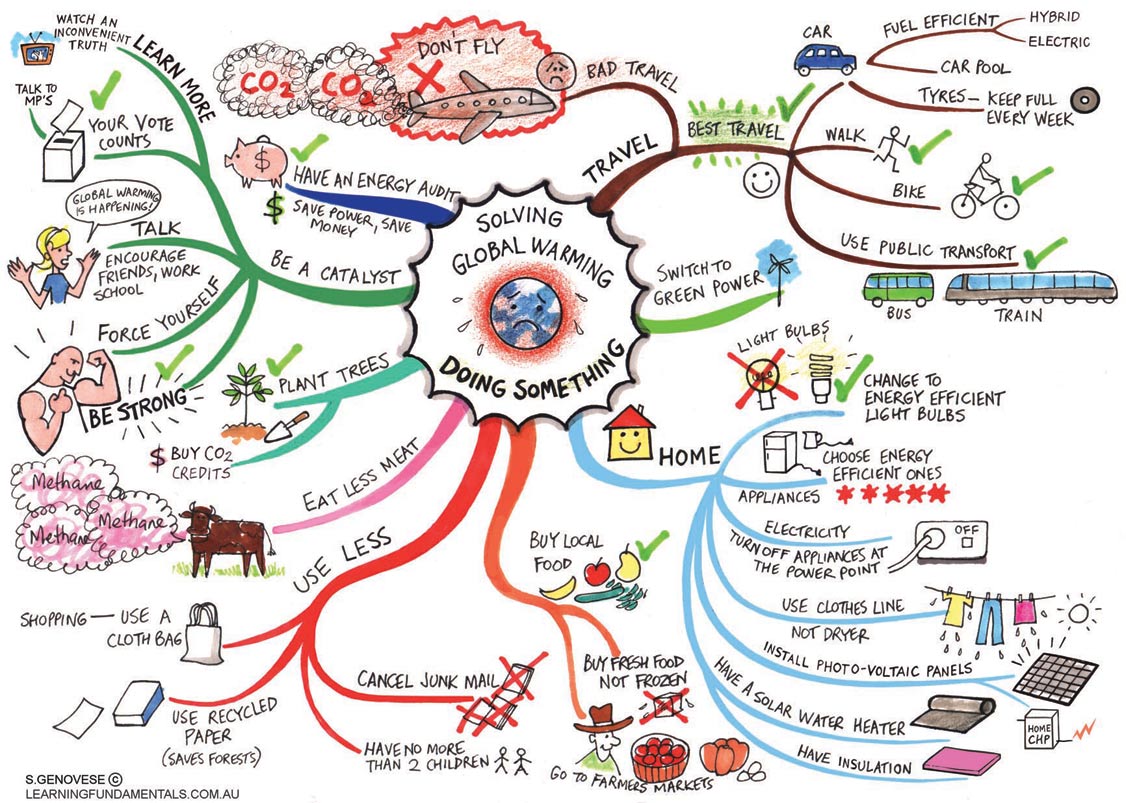
Check out more of such maps in other languages on Live The Solution.
Saturday, 19 July 2008
Cooking? Save time, save egergy.
I like this article about "Cooking for One or Two" by Food and Nutrition Specialist, Julie Garden-Robinson, Ph.D., LRD. She has included tips on reducing portions of ingredients required for a recipe and I like the links to websites that provide simple to cook recipes.
I have learned a new word from her and its “planned-overs” for people who do not like to use “leftovers”. I like the notion of cooking in excess so that your can create another dish with your “planned-overs”.
Recently I fried extra sausages for my children for breakfast. For dinner, I used my “planned-overs” sausages to decorate another mashed potato dish.

That way I saved on gas and time cleaning my frying pan.
Another way to save on time and energy is to find recipes that you can cook quickly. Just google "Cook It Quick .pdf" and you should be able to find many ideas and tips on recipes you are interested in. By do that I found this website, Cook It Quick where you can find some useful kitchen tips.
Try to figure out ways to use less utensils to cook. For example, I learn from Michael Smith that you can use vegetables, such as, carrots, potatoes and onions to replace the rack you need for roasting. Just place your meat on top of the vegetables. Now you do not have an oily rack to clean up.
Watch him on "Chef at Home" and you will be able to catch more tips and tricks that will help shorten your cooking time.
I have learned a new word from her and its “planned-overs” for people who do not like to use “leftovers”. I like the notion of cooking in excess so that your can create another dish with your “planned-overs”.
Recently I fried extra sausages for my children for breakfast. For dinner, I used my “planned-overs” sausages to decorate another mashed potato dish.

That way I saved on gas and time cleaning my frying pan.
Another way to save on time and energy is to find recipes that you can cook quickly. Just google "Cook It Quick .pdf" and you should be able to find many ideas and tips on recipes you are interested in. By do that I found this website, Cook It Quick where you can find some useful kitchen tips.
Try to figure out ways to use less utensils to cook. For example, I learn from Michael Smith that you can use vegetables, such as, carrots, potatoes and onions to replace the rack you need for roasting. Just place your meat on top of the vegetables. Now you do not have an oily rack to clean up.
Watch him on "Chef at Home" and you will be able to catch more tips and tricks that will help shorten your cooking time.
Thursday, 17 July 2008
Don't waste thoes visuals. Stitch them!
You have the fabric and the visuals, now what? Learn to stitch or all those work created by artists on public domain, from years before 1923, will be lost and forgotten.
No fabric? Find them in:
1) clothes your family have outgrown
2) scraps from tailors
3) samples from fabric suppliers or manufacturer
4) netting or clothe packagings
5) Caps
No designs? Check out:
1) listing on Wikipedia:Public domain image resources.
2) my listings on Philosophy Recycled now and then for more leads.
Don't know how to stitch? Learn from Sharon's Dictionary of Stitches for Hand Embroidery and Needlework.
You can also refresh your old tees by painting the free images you have discovered on them.
Like that? Read this:
10 Tips for Fabric Painting
Other material to paint on:
1) Egg
2) Bottles
3) Stones
4) Abandoned Cars
No fabric? Find them in:
1) clothes your family have outgrown
2) scraps from tailors
3) samples from fabric suppliers or manufacturer
4) netting or clothe packagings
5) Caps
No designs? Check out:
1) listing on Wikipedia:Public domain image resources.
2) my listings on Philosophy Recycled now and then for more leads.
Don't know how to stitch? Learn from Sharon's Dictionary of Stitches for Hand Embroidery and Needlework.
You can also refresh your old tees by painting the free images you have discovered on them.


Like that? Read this:
10 Tips for Fabric Painting
Other material to paint on:
1) Egg
2) Bottles
3) Stones
4) Abandoned Cars
Tuesday, 15 July 2008
As easy as eating local or seasonal food.
If you think that reducing energy consumption is a great way to go green, then consider going seasonal or eating food that are grown or prepared locally.
Thursday, 10 July 2008
Muhammad will go to the mountain.
Working on the phrase, "If the mountain will not come to Muhammad, then Muhammad will go to the mountain"; what would you do, other than complaining, when you noticed that people are not recycling as much as they should?
Me? I would ROM, that is, "Research", "Observe" and "Motivate".
First, I do a search and start collecting data from articles I have read and pick up points from members of GreenYes, a forum I am active in. Here are some that I have collected.
From GreenYes members on used beverage containers being trashed at events:
1) Problem observed: Percentage of beverage containers in the trash is directly related to the distance from the trash receptacle to the receptacle (recycling bin) for beverage containers.
Solution: Place containers receptacle (recycling bin) right next to the trash can.
2) People love to set them on either side of a doorway or path.
Solution: Recruiting volunteers to stand by the waste/recycle stations and coach folks in getting their waste into the right receptacle.
3) A useful link posted:
Barrier/Motivation Inventories by Aceti Associates provides influential factors through studies conducted to uncover what would stop or encourage someone to a specific "green" activity.
Here are some observations extracted from Aceti Associates:
1) Sign Strategy: When signs were posted indicating the number of aluminum cans deposited each week in recycling receptacles, can recycling increased by 65% at a Minnesota University.
My take: Place such signs in areas where recyclables are often left behind; either side of a doorway or path.
2) Outreach Volunteer Strategy: When outreach volunteers in Claremont, California personally provided non-recycling neighbors with recycling information, 28% of the non-participants began recycling curbside on a weekly basis. In contrast, when recycling information was simply dropped off to another group of non-recyclers, only 12% recycled every week. Other studies have shown that the outreach volunteer strategy can also be used effectively in drop-off communities.
My Take: Recruiting volunteers earlier mentioned does work.
3) School Recycling Incentive Program: In Cambridge, Massachusetts, monetary and non-monetary incentives, combined with other behavior change tools, led public schools to increase paper recycling by 148% over a period of three years.
My Take: Create ideas that would provide monetary and non-monetary incentives.
4) Commitment Strategy: Residents of Portland, Oregon who signed a commitment to recycle newspaper recycled 253% more than another group that simply had information dropped off at their door. Furthermore, the group that had made a written commitment continued to recycle more than the information-only group even after being informed that their commitment to the project was over.
My take: Brochures or tickets sold at events to include a commitment to recycle form.
5) Waltham Pilot Report: A pilot project conducted in the City of Waltham tested three different strategies that involved distributing a curbside bin decal to residents. The decal displayed photographs of recyclable items.
My Take: Putting trash can and recycling bin together would work better by pasting decal with photograph of recyclable item for each bin.
So, based on these points collected, what can I come up with to motivate Muhammad (recyclables abandoner) to go to the mountain (recycling bins)?
Look out for my write up on CSR Vending; an idea that would provide monetary and non-monetary incentives for recycling beverage cans.
Me? I would ROM, that is, "Research", "Observe" and "Motivate".
First, I do a search and start collecting data from articles I have read and pick up points from members of GreenYes, a forum I am active in. Here are some that I have collected.
From GreenYes members on used beverage containers being trashed at events:
1) Problem observed: Percentage of beverage containers in the trash is directly related to the distance from the trash receptacle to the receptacle (recycling bin) for beverage containers.
Solution: Place containers receptacle (recycling bin) right next to the trash can.
2) People love to set them on either side of a doorway or path.
Solution: Recruiting volunteers to stand by the waste/recycle stations and coach folks in getting their waste into the right receptacle.
3) A useful link posted:
Barrier/Motivation Inventories by Aceti Associates provides influential factors through studies conducted to uncover what would stop or encourage someone to a specific "green" activity.
Here are some observations extracted from Aceti Associates:
1) Sign Strategy: When signs were posted indicating the number of aluminum cans deposited each week in recycling receptacles, can recycling increased by 65% at a Minnesota University.
My take: Place such signs in areas where recyclables are often left behind; either side of a doorway or path.
2) Outreach Volunteer Strategy: When outreach volunteers in Claremont, California personally provided non-recycling neighbors with recycling information, 28% of the non-participants began recycling curbside on a weekly basis. In contrast, when recycling information was simply dropped off to another group of non-recyclers, only 12% recycled every week. Other studies have shown that the outreach volunteer strategy can also be used effectively in drop-off communities.
My Take: Recruiting volunteers earlier mentioned does work.
3) School Recycling Incentive Program: In Cambridge, Massachusetts, monetary and non-monetary incentives, combined with other behavior change tools, led public schools to increase paper recycling by 148% over a period of three years.
My Take: Create ideas that would provide monetary and non-monetary incentives.
4) Commitment Strategy: Residents of Portland, Oregon who signed a commitment to recycle newspaper recycled 253% more than another group that simply had information dropped off at their door. Furthermore, the group that had made a written commitment continued to recycle more than the information-only group even after being informed that their commitment to the project was over.
My take: Brochures or tickets sold at events to include a commitment to recycle form.
5) Waltham Pilot Report: A pilot project conducted in the City of Waltham tested three different strategies that involved distributing a curbside bin decal to residents. The decal displayed photographs of recyclable items.
My Take: Putting trash can and recycling bin together would work better by pasting decal with photograph of recyclable item for each bin.
So, based on these points collected, what can I come up with to motivate Muhammad (recyclables abandoner) to go to the mountain (recycling bins)?
Look out for my write up on CSR Vending; an idea that would provide monetary and non-monetary incentives for recycling beverage cans.
Monday, 7 July 2008
Need photos? Put down that digital camera!
According to Japanese camera industry's statistics, a digital camera uses about twice as much resource and energy compared to the old fashion film camera of the same grade or price. I have a big collection of used batteries to confirm this statement by Ryuji Suzuki of Silver Grain, a company that supplies environmental friendly photographic chemicals.
But going digital is so convenient when there is a need to share lots of photos electronically. So, what can an environmentally conscious blogger like me, who post lots of photos on my blog, do about it?
I put down my digital camera and did a search to learn more about the AAA batteries I have been using. According to Cnet:
1) Rechargeable Nickel-Metal Hydride (NiMH) based batteries are better for the environment than disposables.
2) The lithium type disposable batteries tend to last the longest and make cameras speedier compared to alkaline, oxy-alkaline.
3) Alkalines batteries do not last long and so is not good for the environment
I am on a look out for battery conservation tips and here are some I have spotted:
1) Turn off your digital camera when not in use.
2) LCD viewfinder drains battery.
3) Control using the playback mode after each shot.
4) Compact Flash cards use less power compared to the miniature MicroDrive media hard drives.
I rather like the write up by Health Care Without Harm about the recycling and disposal options of all kind of batteries used in the health care industries. Reading it will give you an idea of the kind of hazardous material each type of battery would produce.
I am also on a look out for sources of free graphics and photos for my blogs.
But going digital is so convenient when there is a need to share lots of photos electronically. So, what can an environmentally conscious blogger like me, who post lots of photos on my blog, do about it?
I put down my digital camera and did a search to learn more about the AAA batteries I have been using. According to Cnet:
1) Rechargeable Nickel-Metal Hydride (NiMH) based batteries are better for the environment than disposables.
2) The lithium type disposable batteries tend to last the longest and make cameras speedier compared to alkaline, oxy-alkaline.
3) Alkalines batteries do not last long and so is not good for the environment
I am on a look out for battery conservation tips and here are some I have spotted:
1) Turn off your digital camera when not in use.
2) LCD viewfinder drains battery.
3) Control using the playback mode after each shot.
4) Compact Flash cards use less power compared to the miniature MicroDrive media hard drives.
I rather like the write up by Health Care Without Harm about the recycling and disposal options of all kind of batteries used in the health care industries. Reading it will give you an idea of the kind of hazardous material each type of battery would produce.
I am also on a look out for sources of free graphics and photos for my blogs.
Friday, 20 June 2008
Keep the flies away! Need more covers?
When the children were younger, they tend to take a longer time to eat their food and more often than not they are not at the dinning table where they should be. What happened was the flies beat them to the food and that meant that the food had to be discarded.
So, does that mean that you need to buy a number of food covers when you have children eating at home?
Not if you are able to get your hands on these plastic covers that come with canned food product, such as, margarine or condensed milk.

Most of these are large enough to cover other canned food. So, if you have any leftover canned food,...

...look through your collection of covers to see if there is any around to fit its top.

They are also the right size to cover the top of the rice bowl we use here.
So, what about items that need a larger cover like this mortar and pestle that I have. The cover I bought is not even large enough for it. And I know for a fact that you can be called away mid chores to attend to the children's demands or to check out if the children have been up to any pranks. So, I should buy a bigger one after all, right?

No. Not if you can find a clean dish cloth that is large enough to cover it.

Cultivate a "1 more need less" mentality and you will have more to spend on what is really needed. A great tips for a Mummy with twins, don't you think so?
So, does that mean that you need to buy a number of food covers when you have children eating at home?
Not if you are able to get your hands on these plastic covers that come with canned food product, such as, margarine or condensed milk.

Most of these are large enough to cover other canned food. So, if you have any leftover canned food,...

...look through your collection of covers to see if there is any around to fit its top.

They are also the right size to cover the top of the rice bowl we use here.
So, what about items that need a larger cover like this mortar and pestle that I have. The cover I bought is not even large enough for it. And I know for a fact that you can be called away mid chores to attend to the children's demands or to check out if the children have been up to any pranks. So, I should buy a bigger one after all, right?

No. Not if you can find a clean dish cloth that is large enough to cover it.

Cultivate a "1 more need less" mentality and you will have more to spend on what is really needed. A great tips for a Mummy with twins, don't you think so?
Why throw away food?
With prices of food going up, the question we should ask ourselves before we consider throwing away any food is, "Why are we throwing away our food?".
Here are some possible answers with links to solutions I discovered.
1) I did not learn the basic of cooking so I tend to cook in access of need. Sometimes the dish did not turn out well due to my inexperience.
2) I do know not how to cook with leftovers. Maybe I should join a forum about cooking?
3) I did not know what I have that foodstuff in my fridge and discovered it too late. How long should I keep that in my fridge?
4) I did not know that there are people around with insufficient to eat. Where can I send my excess food to?
5) I did not know that some local food outlets and franchises discard their stock about 3 days before their expiry dates, just to maintain their standards for freshness. If I can collect such food, surplus, distressed or damaged food and grocery items where can I send them to?
6) I did not know that I can start a Community Kitchen with of donated food and grocery product? Other than through donations, how would a non profit organisation like Second Harvest in America run?
7) Where else can I learn about making use of leftovers? How about from those in the record-setting food recovery programs highlighted by EPA?
8) What other facts should I know about?
What about those who eat out or do take-aways? Maybe you should first find out how others are rating drinks, food or outlets you intend to eat at. If the ratings are high on the food you picked, there would be nothing left on your plate to waste.
So, before you throw your food away, find out if they are any ideas here that you can make use of.
Here are some possible answers with links to solutions I discovered.
1) I did not learn the basic of cooking so I tend to cook in access of need. Sometimes the dish did not turn out well due to my inexperience.
2) I do know not how to cook with leftovers. Maybe I should join a forum about cooking?
3) I did not know what I have that foodstuff in my fridge and discovered it too late. How long should I keep that in my fridge?
4) I did not know that there are people around with insufficient to eat. Where can I send my excess food to?
5) I did not know that some local food outlets and franchises discard their stock about 3 days before their expiry dates, just to maintain their standards for freshness. If I can collect such food, surplus, distressed or damaged food and grocery items where can I send them to?
6) I did not know that I can start a Community Kitchen with of donated food and grocery product? Other than through donations, how would a non profit organisation like Second Harvest in America run?
7) Where else can I learn about making use of leftovers? How about from those in the record-setting food recovery programs highlighted by EPA?
8) What other facts should I know about?
What about those who eat out or do take-aways? Maybe you should first find out how others are rating drinks, food or outlets you intend to eat at. If the ratings are high on the food you picked, there would be nothing left on your plate to waste.
So, before you throw your food away, find out if they are any ideas here that you can make use of.
Subscribe to:
Posts (Atom)