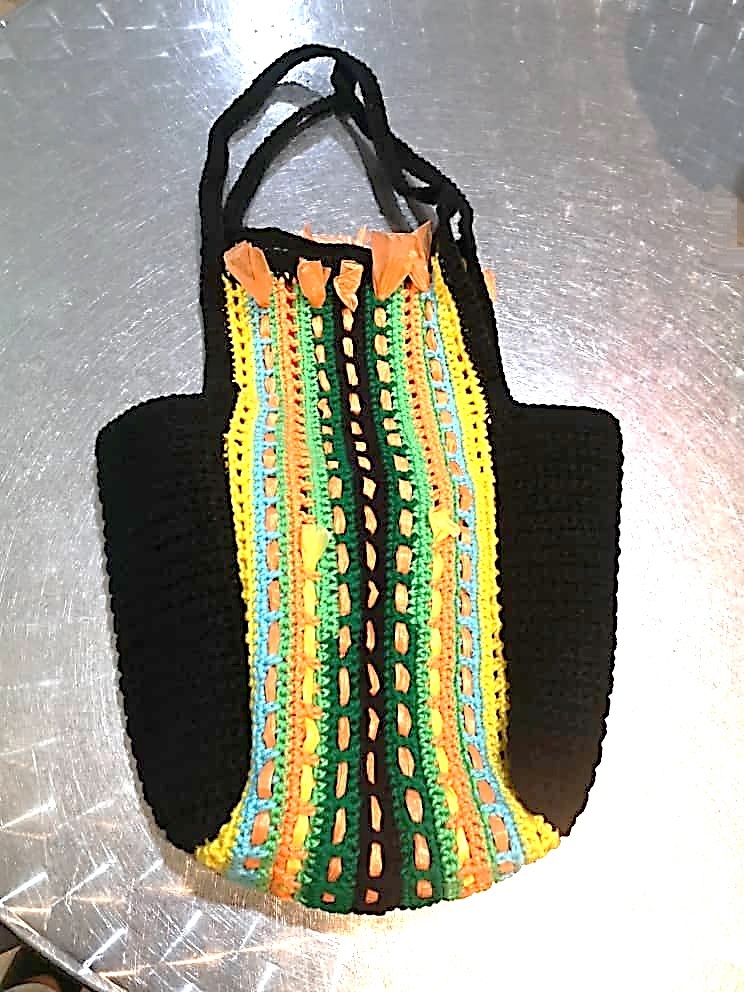
The art of recycling for a greener environment starts with seeing trash as "abandoned material" so that we can create "Abundance from the Abandoned" in "Amazing Ways".
I have been receiving lots of reusable bags. The handles of some of them are not strong enough to handle load and some have issues at the seams. I think the best way to make them last is to use them as inserts for crochet bags. I decided to use this 22x17cm bag for the project.
And this is the crochet bag pattern that I chose to make.
I have to increase the stitches so that the insert fits in perfectly.
I turned the reusable bag inside out, so that the print will not show, before inserting it into the crochet bag.
When you use a thick yarn and choose a crochet pattern with large holes, you use less wool and complete the bag faster. If you do not have a reusable bag to use as an insert, you can weave your old scaves or leftover ribbons and whatever suitable material that you can weave through the holes.
Use your imagination to personalise your crochet bag. I would not mind using cut strips of plastic bags as weaving material as I have always try to make use of discarded material in my handwork.
Will you be ashamed if you decorate your bag with plastic bags?
I can also change the design of my crochet bag by sewing a granny square on it so that I can use it as a pocket for holding stuff like cards or a set of keys.
Wednesday, 8 March 2023
I like keeping empty bottles with grooves on them. They make it easier for me to cut the bottles neatly to the height I want. I use this 1L size oval shaped container to store all the brushes I used in my kitchen. Sometimes I will also leave my knives with the brushes to drain them after washing.
Check out how I decorate the empty containers I used for storing my stuff. The one decorated with granny squares was actually a lantern I made for my children. These 5L cooking oil bottles are great for storing my packets of coffee, onions and tubers.
Other than using them as storage containers, I also use them like a pail for soaking in water:
-my laddles to soften food stuck on them to make it easier to clean. -my vegetables like celery, beans, tomatoes, bell peppers. I place a prestle or a cup on top to make sure that the vegetables stay in the water.
Recently, I discovered that it is a great way to keep the shape of my crochet bag. I made it because my sister told me that, while at work, she don't like to carry her handbag out for lunch and that she is looking for a small bag big enough to hold just her keys, handphone and a packet of tissue. The first one I made did not hold its shape well once she puts her stuff in.
I like this version better.
She can decide how much of the bottle she would like to cut off to hold her stuff. The cord I used as a handle was taken off a shopping bag.
So, she can easily change the colour with cords she can find from her own collection of paperbags. She can even use her shoes laces.
I chose a pattern with large holes so that she can slip receipts through them as it will be easier for her to remove them to show the staff when her dishes are ready for collection. She can also personalise it by inserting one of those drawstring bags we often received with gifts.
I hope she will consider inserting cut strips of plastic bag through the holes to match her outfit like I did for this bag I made with leftover wools.
Are you wondering if you should buy drinks that are packed in aluminum cans or in PET bottles?
It depends on which country you are from and how the recycling rate is like for the packaging involved. Recycling agents in Malaysia would rather take aluminium cans over plastic as one lorry load of aluminium cans earns more than one lorry load of PET bottles.
I read this article posted on July 20, 2019 by TAPP Water:
% recovered for recycling in USA
Glass 80%
ALUMINIUM 45%
PLASTIC (PET) 9.5%
Though the recycling rate in reported is 80% for glass bottle, in Malaysia I am not able to find recycling agents for them.
If you read the report, "Disposable Drinking Bottles- Plastic vs. Glass vs. Aluminum" from Macquarie University in Australia website, the recycling rate is different:
Average Amount Currently Recycled reported in Australia
GLASS 50%
ALUMINIUM 50%
PLASTIC (PET) 60%
Maybe it is easier to make a decision based on your views from this report extracted from the report posted at TAPP Water:
Time to decompose
Glass bottle 1 million years*
Single use plastic 400 years
Carton Never**
Aluminium can 100-400 years
Decomposition residue
Glass bottle - Glass
Single use plastic - Microplastics
Carton - Some microplastics
Aluminium can - Metal scrap
How do you stop microplastics from polluting the environment? Based on this, I would rather choose aluminium over PET bottles.
If you still cannot make up your own mind on it, read what "The Aluminum Association" has to say about it.
Extracted:
"Nearly 75 percent of all aluminum ever produced is still in use today.
Infinitely recyclable and highly durable, nearly 75 percent of all aluminum ever produced is still in use today. Aluminum is 100 percent recyclable and retains its properties indefinitely. Aluminum is one of the only materials in the consumer disposal stream that more than pays for the cost of its own collection."
See how Tetrapak is recycled in India to benefit the public.
Tetrapak is working on raising awareness that their cartons can be recycled. I think that children in school should be taught during their art and craft class lessons on how they can extract paper out of cartons as shown in this video.
Are you wondering what happen to the TetraPak cartons that you had diligently put out for recycling?
In Thailand, under the Green Roof project, with the support of local charity, Tetra Pak turn recycled cartons into roofing sheets to provide emergency shelter for people in need.
See how TetraPak cartons are collected in India and made into benches to be placed at public parks and school.
You can learn to do it on a small scale by watching this video.
Most DIY instructions I read use 100% cotton fabric to make the wrap. The reason is, if you use stretchable material like cut outs from your old t-shirt, the beeswax may not able to coat the surface fully or the wax may crack once you stretch the finished product.
I read from the instruction posted at Apartment Therapy that “the best options for fabric are something about the thickness of a bed sheet with a very tight weave”. So you can consider using your used bedsheet to make beeswax wrap.
From that article I discovered how partially waxed wraps can be saved by using the beeswax beads or pellets and parchment paper method. You can sprinkle a small amount of wax beads on those areas that did not get waxed, place a parchment paper over un-waxed side of the fabric and iron over it.
So, now I know, there are actually other ways to making beeswax wrap. You can also learn the methods and how to use your wraps by watching this video.
Another discovery I made is that you can even make Beeless Vegan Food Wraps! You use carnauba wax or candelilla wax flakes with jojoba oil as shown in this video.